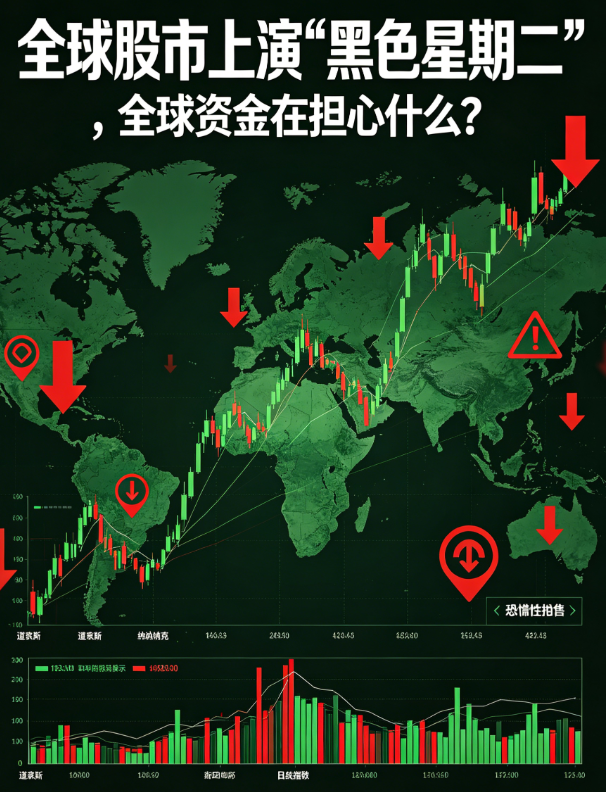
Global Stock Markets' "Black Tuesday" Selloff: When AI Expectations Hit a Correction Point
Keywords: Global stocks, AI stocks, semiconductors, memory, HBM, investment capital, Nasdaq, Samsung Electronics, SK Hynix, tech market
Introduction
Global stock markets just experienced a highly volatile trading session, which many investors are calling "Black Tuesday." Major markets fell almost simultaneously: South Korea's KOSPI dropped 9.99%, the US Nasdaq fell over 2%, and both China's A-shares and Hong Kong markets lost more than 1%. Notably, AI and semiconductor-related stocks were at the center of the selloff.
This decline is not just a short-term pullback; it reflects a significant shift in market expectations regarding the growth cycle of the tech industry, especially memory and AI infrastructure. Previous gains were too large and lasted too long, and once signs of slowing growth appeared, large-scale profit-taking was triggered.
Widespread Selloff in Memory and AI Stocks
In South Korea, the KOSPI's near-10% drop was mainly driven by sharp declines in the two "memory giants" SK Hynix and Samsung Electronics, both falling over 12%. Beyond that, global memory chip-related stocks also experienced pressure: Micron Technology fell 13.18%, Kioxia dropped over 15%, SoftBank fell more than 10%...
Notably, this correction did not stem from a single company's issue but a sector-wide decline. When leading companies in the semiconductor supply chain weaken simultaneously, the market realizes the problem is no longer just individual corporate earnings but the broader valuation logic of the entire industry.
Root Cause: Profit-Taking After a Massive Rally
Essentially, this sharp decline began after an excessively rapid rally. In recent months, semiconductor stocks—especially those related to memory and HBM—have risen much faster than the broader market. When valuations run far ahead of actual earnings, profit-taking pressure becomes unavoidable.
After share prices multiplied several times, a 10% to 20% pullback is often still considered normal volatility in a hot cycle. However, if the market falls more than 20% from its peak and enters a technical bear market, investor sentiment turns markedly cautious. Therefore, the current selloff does not necessarily mean the end of the tech uptrend, but it is undoubtedly a clear warning.
Direct Trigger: Concerns Over Tech Giants' Massive Capex
If the indirect cause is expensive valuations, the direct cause points to a more critical question: Is the AI investment cycle approaching a peak?
Large tech groups like Microsoft, Google, Amazon, and Meta are typically seen as "cash cows," but even they are facing increasingly heavy infrastructure investment burdens. In 2026 alone, total capital expenditure for this group is expected to approach $800 billion, and the market even projects it could exceed $1 trillion in the coming years.
This figure shows that the AI race is no longer just experimental but has entered an industrial-scale cash-burning phase. When investment spending grows faster than returns, investors begin to question the sustainability of cash flows from GPUs, memory, and data center infrastructure. If any sign of capex slowdown appears, it could trigger a strong revaluation across the entire AI stock chain.
Memory Price Surge and Its Spread Across the Chain
Since the beginning of the year, prices of various memory products like DRAM and NAND Flash have surged, with some categories seeing cumulative gains of over 200%. In an environment of rising input costs, this price wave is spreading from core components to hardware, equipment, and even end applications.
This has two consequences. First, profits in the AI industry chain are increasingly concentrated in a few companies with strong pricing power. Second, if input costs continue to rise while end demand slows, margins across the ecosystem may be compressed. Therefore, the correction in memory stocks reflects not just changes in chip supply and demand but also market concerns about the industry's ability to sustain profit growth.
Who Benefits Most from the AI Boom?
According to public data, in the global AI hardware value chain, the US captures nearly 50% of the profits, South Korea about 35%, and the rest shared by other economies. In other words, the US and South Korea together account for about 85% of AI hardware profits.
However, note that most capital expenditure is concentrated in the US, where cloud giants like Microsoft, Google, Amazon, and Meta are based. Even so, the US actually takes only about half of the profits from the entire chain, while South Korea, leveraging its advantages in memory and HBM manufacturing, is in a "free-riding" position. That's why whenever AI expectations change, South Korea is often one of the most strongly affected markets.
Currently, the two most profitable segments in the AI ecosystem are GPUs and HBM. In the HBM space, the top three global memory giants have mass production capabilities, with two in South Korea and one in the US. China's ChangXin Memory Technologies (CXMT) has risen to fourth globally in DRAM but still lags significantly in large-scale HBM production. This shows that the high-end memory market remains highly concentrated, and any demand change can significantly impact stock prices.
Biggest Risk: Slowing CAPEX Growth
The market's biggest worry is not a single day's crash but that the AI investment cycle may be approaching a relative saturation phase. If large cloud computing groups start to slow capex growth, demand for GPUs and HBM will also weaken. At that point, semiconductor companies' expected revenues will be revised down, and industry valuations will follow.
That's why "CAPEX uncertainty" became the trigger for the global selloff. Investors fear that today's massive investment levels cannot continue forever, and the market may be entering a phase of reassessing the true growth rate of AI. If this judgment holds, tech stocks that have been driving the market will face significant pressure.
Conclusion
The global stock market's "Black Tuesday" reminds us that no uptrend lasts forever. AI and semiconductor stocks had a hot rally, and a correction was always likely. But the magnitude and speed of this decline show the market is particularly sensitive to two variables: tech giants' capital expenditure and the true growth prospects of the AI cycle.
In the short term, sharp volatility may continue. In the medium term, if CAPEX remains high, semiconductors still have room to grow; but if investment slows, the market may undergo a deeper revaluation of the entire tech stock group. For investors, now is the time to stay cautious, prioritize risk management, and closely monitor signals from the global AI supply chain.