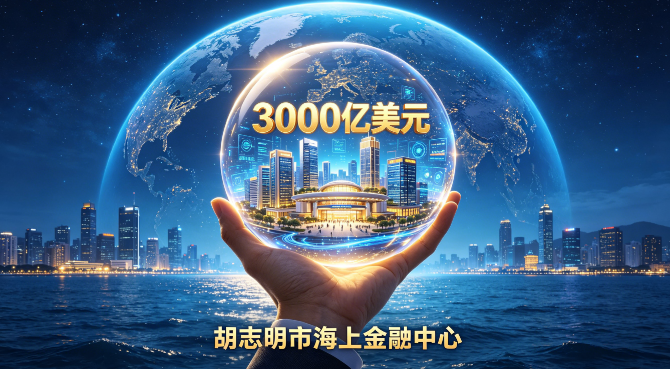
At the 2026 Financial Forum in Ho Chi Minh City, Vice Chairman of the Executive Board of the Vietnam International Financial Center in HCMC Nguyen Huu Huan said the cargo value through HCMC's seaport system is estimated at over $1 trillion annually.
"Despite having a major transshipment port cluster, about 80% to 90% of financial transactions related to these cargo flows are still conducted in Singapore and Hong Kong," he said.
To fill this market gap, a maritime financial ecosystem will be launched, including a maritime financial exchange operating on a "port-to-finance" model. Under this framework, all data related to cargo, shipping contracts, electronic bills of lading, and payment flows will be standardized into financial data.
Based on these data flows, Nguyen added that stable cash flows from cargo handling and warehousing services can be structured into infrastructure bonds, investment funds, or securitized products to attract long-term international capital, while making green port projects easier to access ESG financing.
"This strategic move aims to transform HCMC from a city that merely operates ports and collects cargo handling fees into a capital hub for Vietnam's broader maritime economy. The ecosystem has already attracted participation from several large financial institutions and logistics companies, including Gemadept, Saigon Port, HDBank, and many international firms," he said.
The Vietnam International Financial Center also established an aviation finance center in February, which has raised about $6.1 billion in committed capital from Boeing, Airbus, and Dubai financial institutions.
A fintech center has also been launched with participation from major firms like Momo, NAPAS, Ant International, and Bank of China.
One of the most notable mechanisms is the regulatory sandbox, a controlled testing framework for new financial models, with priority areas including cross-border payments and tokenization.
Meanwhile, the HCMC Vietnam International Financial Center is also advancing the establishment of an international stock exchange and has signed cooperation agreements with Nasdaq and the London Stock Exchange to develop trading systems and cross-listing mechanisms.
"Our goal is for Vietnamese companies to raise international capital directly in HCMC, while domestic investors can also trade international stocks like Google, Amazon, or Microsoft," Nguyen said.
According to Dr. Tran Van Loc, member of the National Financial and Monetary Policy Advisory Council, developing an international financial center is a necessary step for Vietnam to seek additional resources to maintain high economic growth in the coming years.
To achieve about 10% growth, Vietnam needs to mobilize about $280 billion in total social investment capital annually. HCMC alone is estimated to need about $50-60 billion per year. Meanwhile, bank credit currently accounts for more than half of the economy's total capital supply.
"Capital markets, including stocks, bonds, and investment funds, currently contribute only about 14% to 15%. This ratio needs to double in the coming years to reduce pressure on the banking system," Tran Van Loc said.
Notably, Tran Van Loc highlighted tokenization as a potential new channel for capital mobilization in the coming years.
"In this model, large assets like a VND10 billion (approx. $384,000) property can be divided into smaller ownership units, allowing multiple investors to participate," Tran Van Loc said.
However, alongside capital mobilization opportunities, the development of an international financial center will impose higher requirements on businesses and the workforce.
"Working in the international financial center ecosystem will require strong English skills, professional work standards, and a solid understanding of international legal frameworks. Meanwhile, businesses need to improve governance and innovation capabilities, especially as Vietnamese companies' investment in new product R&D currently stands at only about 9%, far below the global average of about 28%," Tran Van Loc said.
According to Chairman of the HCMC Business Association Nguyen Ngoc Hoa, supporting businesses to seize opportunities from the international financial center is one of the organization's priorities for the coming period.
The international financial center is also expected to support SMEs in raising capital, with a target mobilization scale of about $769,000 annually. However, participating businesses need to meet strict standards in corporate governance, financial transparency, and operational capacity.
"Even with favorable mechanisms, businesses that fail to prepare adequately or lack capacity to participate may miss important opportunities in the next development phase," Nguyen Ngoc Hoa said.
Research by the World Bank and ADB estimates that Vietnam currently needs about $15-17 billion annually for climate adaptation and sustainable infrastructure development projects. However, the state budget can currently meet only about 30% to 35%, with the rest needing to come from the private sector.