Title: MSCI and Vietnam Stock Market Upgrade Prospects: How Far Have Reforms Progressed?
Keywords: MSCI, Vietnam stock market, market upgrade, market access, foreign investors, CCP, English disclosure, clearing, financial reform
Introduction
In the early hours of June 19, MSCI—one of the most influential index providers in global financial markets—released its 2026 Global Market Accessibility Review. In the report, MSCI noted that Vietnam continues to advance its capital market reform agenda, rolling out a series of important changes, especially measures aimed at facilitating foreign investor participation.
Notably, the market is now focused not only on progress in the accessibility assessment but also on the annual market classification review expected to be released in the early hours of June 24. That document has a more direct impact on whether the market will be upgraded or placed on the watch list for an upgrade. Nonetheless, MSCI's latest report remains crucial as it clearly reflects Vietnam's reform progress in aligning with international standards.
Against a backdrop of increasingly cautious global capital flows, improving market infrastructure, transparency, and foreign investor access is no longer just a technical option but a baseline requirement to enhance the appeal of Vietnam's stock market. MSCI's latest update shows Vietnam is taking a new step, but also highlights that many obstacles remain to be cleared.
Significant Progress in Market Reforms
According to MSCI, Vietnam has significantly accelerated its capital market reform process during the latest assessment period. The most prominent advancement is the introduction of the Global Broker Model—a mechanism allowing foreign investors to access the market without opening a local trading account in Vietnam. This is a major change, as for years, account opening and local trading procedures were seen as barriers increasing compliance costs for foreign investors.
Essentially, this model greatly simplifies market access, reduces operational hurdles, and brings Vietnam's trading practices closer to international norms. For global institutional investors, operational convenience often directly affects capital allocation decisions. Therefore, Vietnam's willingness to change at the trading infrastructure level is seen as a positive signal of its determination to increase market openness.
Additionally, MSCI confirmed that the central counterparty clearing (CCP) mechanism has been formally established and is expected to start operating in early 2027. This is a major milestone in modernizing Vietnam's stock market clearing and settlement system. Once operational, the CCP will lay the foundation for a clearing and settlement framework closer to international standards, while supporting the full implementation of a pre-funding-free trading mechanism.
Technically, the CCP helps reduce counterparty risk, enhance system security, and increase investor flexibility. For markets seeking an upgrade, this is not just a technical or process improvement; it signifies a steady enhancement of market infrastructure in a more sustainable direction.
Another important reform highlighted by MSCI is the roadmap for English-language disclosure. According to the plan, the Ministry of Finance will implement this requirement in phases from January 1, 2025, to January 1, 2028. The policy aims to increase transparency and make information more accessible to international investors.
This is a substantive move, because in modern capital markets, information must not only be complete but also easily accessible, comparable, and timely. For foreign investors, a lack of English information often increases analysis costs, prolongs decision-making, and reduces willingness to participate. As Vietnam pushes harder for bilingual disclosure, market competitiveness will significantly improve.
Remaining Obstacles
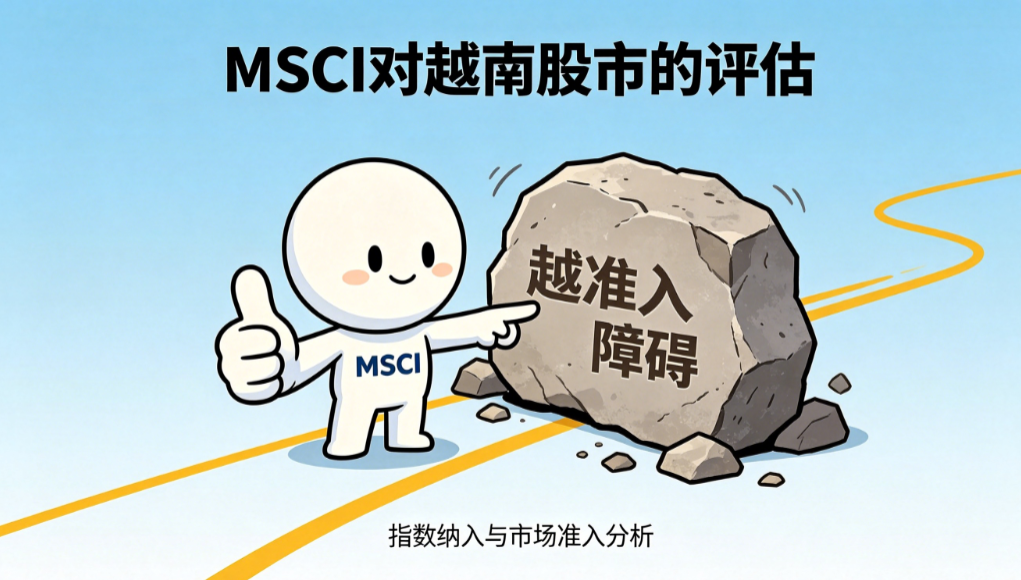
While MSCI acknowledged recent progress, it also pointed out a series of limitations affecting Vietnam's market accessibility. This indicates that despite reforms, structural bottlenecks remain far from resolved.
First, MSCI noted that foreign ownership limits in conditional business sectors range from 0% to 75%, affecting more than 10% of total market capitalization of Vietnam's stocks. This is a fundamental issue, as ownership caps not only limit strategic investors' ability to deploy capital but also reduce the attractiveness of many large-cap stocks.
In practice, many leading listed companies have already reached their foreign ownership limits, leaving little room for international capital despite continued demand. MSCI also noted that more than 1% of constituents in the MSCI Vietnam Investable Market Index are still affected by these restrictions. This means the foreign ownership issue is no longer just a problem for a few companies but is beginning to impact index construction and global capital allocation.
Beyond ownership restrictions, MSCI believes the principle of equal treatment for domestic and foreign investors is not yet fully guaranteed. Some corporate information is still not disclosed in English, and foreign investor access remains subject to ownership regulations. From a global investor's perspective, this inconsistency means market access has not truly reached the openness level of international standards.
On the foreign exchange front, MSCI stated that Vietnam has not yet developed an offshore currency market. Meanwhile, domestic foreign exchange transactions remain closely tied to spot stock trading, offering less flexibility compared to some other emerging markets. This makes it harder for international investors to manage currency risk, especially in large-scale allocation strategies or portfolio trading.
In clearing and settlement, while a pre-funding-free solution is not yet operational, the market must wait for the full deployment of the CCP model in 2027. In other words, the system is moving in the right direction but has not yet reached the complete state expected by global institutional investors.
MSCI also noted that over-the-counter transfer trading has improved after recent regulatory adjustments. However, some transactions still require document review by the Vietnam Securities Depository and Clearing Corporation before execution. This indicates that there are still several procedural aspects in market operations that need further simplification to enhance processing speed and flexibility.
What the Report Means for the Upgrade Outlook
It is important to distinguish that this newly released report focuses primarily on market accessibility, not the annual market classification review. Therefore, it is not a direct basis for an upgrade decision. However, the report still holds great value as it reflects Vietnam's actual progress in meeting technical requirements—a key foundation for future upgrade prospects.
In other words, the accessibility assessment is like an entrance exam showing how much the market has structurally improved; the market classification review is the final judgment on upgrade prospects. If Vietnam maintains its current reform pace, especially regarding foreign ownership limits, disclosure transparency, clearing and settlement, and foreign exchange infrastructure, the case for an upgrade will become increasingly clear.
From a policy perspective, this is also an important moment for Vietnam to demonstrate that reforms are not just on paper or in roadmaps, but are being effectively implemented. International investors typically evaluate a market not just by commitments but by stability, predictability, and consistency of execution. If new reforms are properly implemented, it will create a double positive effect: boosting market confidence and enhancing the ability to attract long-term capital.
Impact on the Market and Investors
For the market, the reforms identified by MSCI are expected to have positive impacts at multiple levels. First, they help improve Vietnam's image among global investment funds, especially index trackers and passive funds. As access barriers are gradually removed, the market's visibility to large capital flows will increase.
Second, improved trading and settlement mechanisms will help reduce systemic risk, thereby increasing market reliability. For institutional investors, infrastructure is often as important as corporate growth stories or valuation appeal. Markets with transparent, convenient, and low-friction operating mechanisms are usually better able to retain capital over the long term.
Third, if the English disclosure roadmap is implemented as planned, the research quality and international coverage of the Vietnam market will significantly improve. As corporate data becomes more accessible, valuations will more fully reflect fundamentals, helping markets become more efficient.
However, investors should remain cautious about short-term expectations. Capital market reform is a multi-layered process that takes time to prove its effectiveness in practice. The changes mentioned today will only create real value when they operate stably, coherently, and consistently over multiple consecutive assessment cycles.
Conclusion
MSCI's latest report shows that Vietnam has made significant progress on the path of reform and market opening. The adoption of the Global Broker Model, the establishment of the CCP mechanism, and the roadmap for expanding English disclosure are all very positive signals, reflecting a determination to upgrade market infrastructure to international standards.
However, obstacles related to foreign ownership limits, insufficient bilingual disclosure, foreign exchange market limitations, and incomplete clearing and settlement procedures indicate that Vietnam still has substantial work to do. MSCI has acknowledged the progress but also emphasizes that reforms need time to demonstrate their actual effects.
In the short term, market focus will be on the annual market classification review expected on June 24. But in the long run, the most important thing is not any single assessment, but whether Vietnam can maintain reform momentum in a sustained, broad, and practical manner. If it can, the upgrade prospect will no longer seem distant but will gradually become an inevitable result of serious and consistent preparation.